Should elections using approval voting have a primary and should primary elections even exist? My answers: “sure” and “yes!”.
Rob LeGrand posted “Approval Voting is better without runoffs” a few years ago, and based on some of what I’ve seen on Discord/etc, he stands by what he wrote. Though I’m virtually certain he has done more modeling of elections than I have, I have to disagree with him. Elections are about so much more than the math.
A lot of discussions about voting methods focus narrowly on ballot mechanics, but U.S. elections actually operate in three distinct phases:
- Signature gathering
- The primary election
- The general election
Some electoral-reform advocates ignore problems with the signature gathering process, and then suggest we can skip the primary election and just have candidates gather signatures to qualify for the general-election ballot. Some will openly dismiss the need for political parties in large-scale elections. The latter view overlooks a very critical role that political parties play for candidates: to maintain databases of likely voters and their political leanings, to provide administrative/legal support for maintaining ballot access, to foster nascent but promising candidates, and to mobilize an army of like-minded volunteer door knockers for the general election campaign. The parties provide brand labels that help voters sort through a sea of candidates. Bypassing political parties means subjecting candidates (and voters) to the privatized process of signature gathering that seems vulnerable to fraud and identity-theft risks, and lacks serious public oversight. Treating signatures as the main gatekeeping mechanism ignores how dodgy and difficult that landscape actually is.
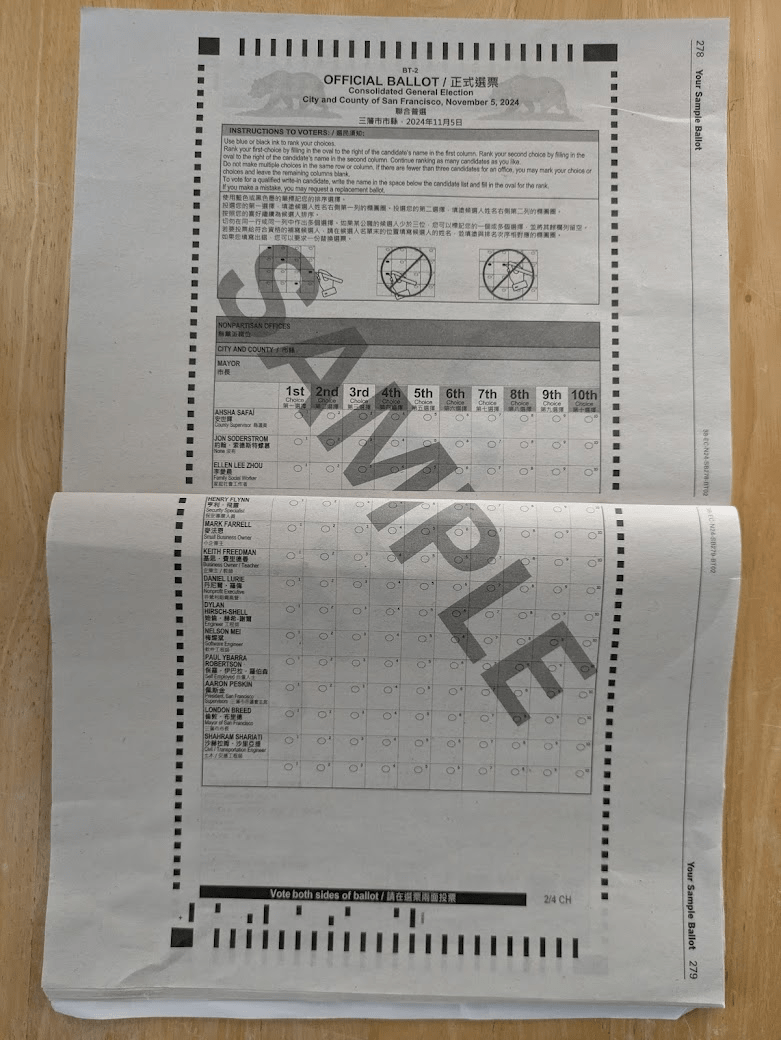
Moreover, it’s easy for wonks to assume that voting is easy, but they often fail to realize that most voters aren’t as politically informed or eager to vote as folks that call themselves “wonks”. A typical voter, when confronted with a ballot that has 20 races each having 5 to 15 candidates per race, will often be inclined to skip the voting process, and even when they do vote, may take shortcuts due to voter fatigue. In many states, in addition to having to elect the U.S. president, maybe a U.S. senator, a U.S. representative, probably a state senator, a state representative, maybe a mayor, maybe a city council member, maybe a controller, maybe a coroner, and maybe a dogcatcher (or catcatcher, or whatever). Additionally, voters are frequently asked to weigh in on several ballot measures. Those ballot measures MAY be accurately summarized in the voting guide, but there’s no guarantee.
Many voters look at long, complicated ballots, and think “maybe this democracy thing is overrated“. We ask voters to do a lot of work vetting stuff on their general-election ballots, and in some jurisdictions, we ask folks to come back to the ballot box several times a year. Democracy isn’t as popular in the United States as it used to be.
I think a primary can serve many purposes:
- Prune down the number of candidates to a reasonable number. In no-primary San Francisco, we had to rank 13 candidates in the general election. The debates and the press coverage were a mess, because many outlets decided to only acknowledge four or five of them. Having a reasonable number on the ballot means it’smore reasonable to expect voters to research all of the options, and for the debate stage to have a reasonable number of people on it.
- It would let voters in the primary election have a “what the hell” candidate they approve (because…why not?). In addition to voting for their favorite “viable” candidate(s), they could vote for likable and seemingly competent but allegedly non-viable candidates in the primary, and if turns out they were incorrect, and enough other folks felt the same way, well, the candidate advances to the general election and can get scrutinized more closely then.
- Speaking of “what the hell” candidates, it might make voters more inclined to sign petitions for getting more candidates on the ballot for the primary. Or, maybe we could let candidates get on the ballot with fewer signatures
Approval voting would work really well as a system to use in both the primary and general election. For those that object to the “top-two” form of primary, a “threshold-based” system could be used to advance all candidates that get over 50% approval (or 40% approval, or some arbitrary threshold). The percentage chosen isn’t as important as having a fixed threshold. It encourages candidates in the primary to try to increase their approval percentage without feeling compelled to tear down specific opponents. All candidates who reach the threshold advance to the general election, and the same style of ballot can be used in the general election to select the final candidate.
Ideas like eliminating primaries often come from treating elections as puzzles to solve, rather than institutions that must work for thousands or millions of voters. What’s worse is when a single, bubble-packed ballot is promoted as “cheaper” than running a separate election, which just shifts complexity and cost onto voters. We deserve better.
 RoBlaBlog
[…] link: https://robla.blog/2026/01/17/should-approval-voting-have-a-primary/ […]